How Much Does Custom Software Cost?
The honest answer is: it depends — but not in a way that should frustrate you. Here is what actually drives the cost of custom software, and what a realistic budget looks like.
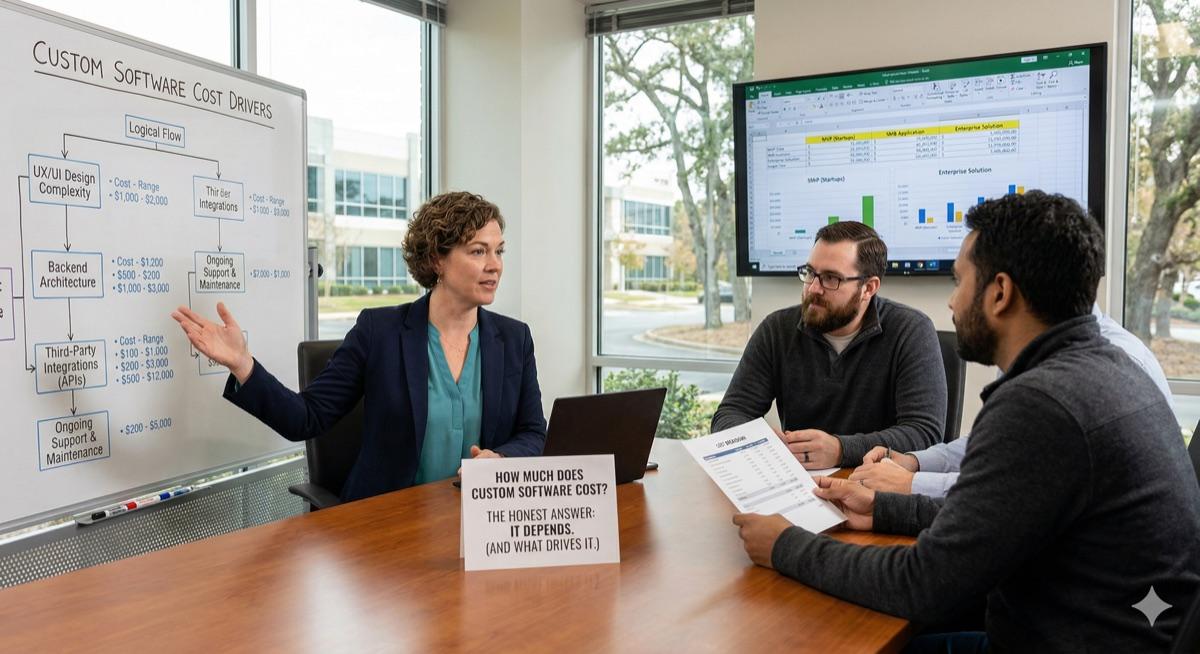
Why “it depends” is actually a useful answer
Every developer you ask will say “it depends” — and most business owners hear that as a dodge. It is not. Cost is genuinely driven by scope, and scope varies enormously.
A simple internal tool for five employees — a dashboard, a tracker, a reporting portal — is a fundamentally different project from a customer-facing application with payment processing, public user accounts, and third-party integrations. The number of users, the complexity of workflows, the number of distinct roles (admin vs. staff vs. customer), and whether the tool faces the public or stays internal: all of these move the number significantly. “It depends” means the right answer requires a real conversation about your situation.
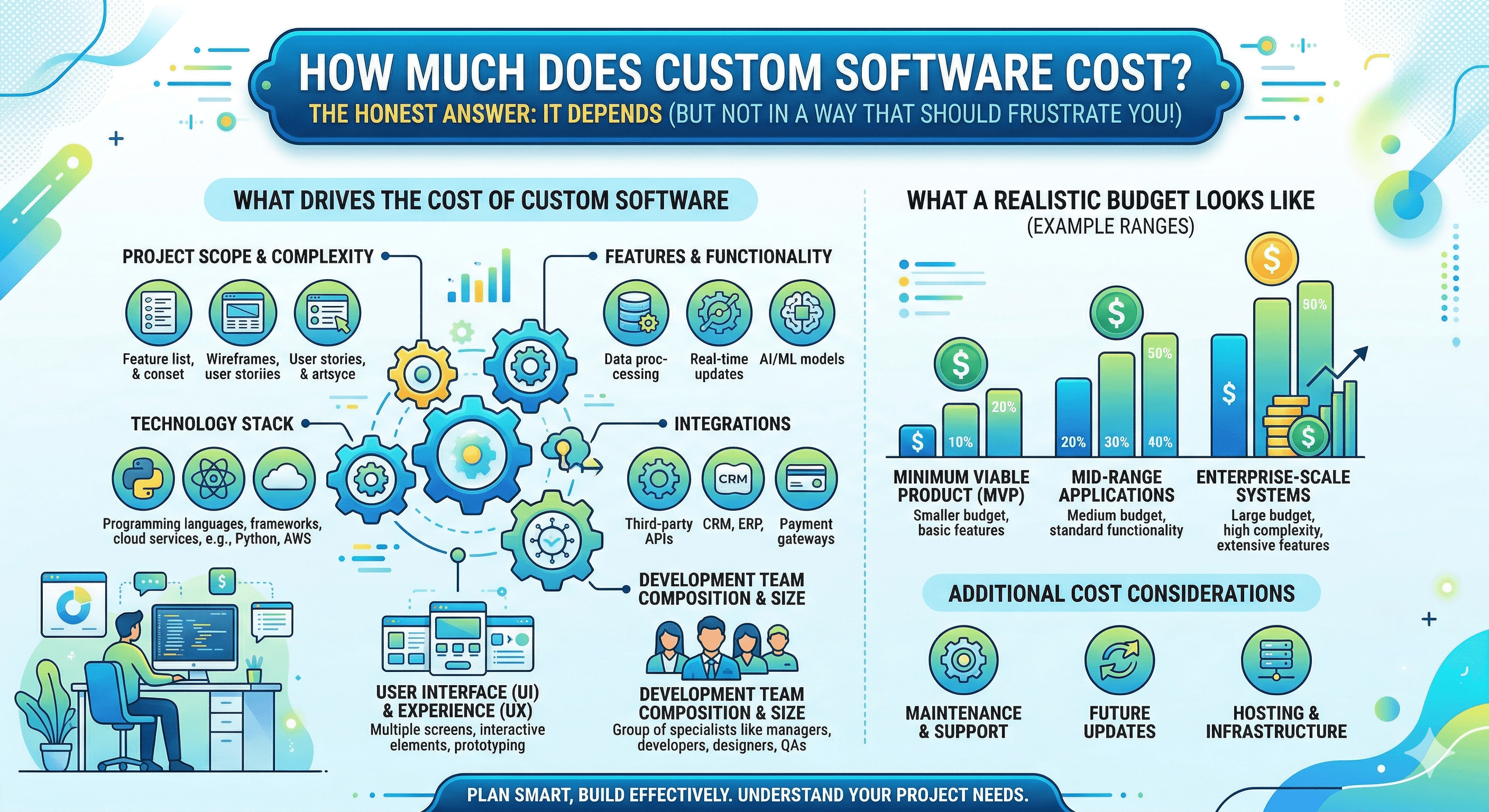
The real cost drivers
These are the factors that actually determine what a custom build costs:
- Number of distinct user roles — each role typically means separate views, permissions, and workflows.
- Third-party integrations — connecting to Stripe, QuickBooks, or any external API adds coordination and testing time.
- Whether it needs a mobile app — a responsive web app and a native mobile app are different scopes entirely.
- Data migration from legacy systems — moving existing records from spreadsheets or old software adds meaningful work.
- Ongoing support and maintenance — a Care Plan after launch is separate from the build cost.
What custom software is NOT
There are two myths worth clearing up directly.
First: custom software is not always a six-figure investment. That ceiling exists for enterprise systems with hundreds of users and deep integrations. Most tools built for small and mid-size businesses land well below that. Many SMB projects fall in the $8,000–$40,000 range depending on scope.
Second: it is not a multi-year project. The “two years to build software” timeline belongs to large organizations with committee-driven requirements and internal politics. Most Kairos builds ship in 6–16 weeks. Scope is defined, work begins, and you get a working product on a predictable schedule.
How the fixed-price model changes everything
When you work with a firm that bills by the hour, cost uncertainty is a feature of the engagement — not a bug. Every conversation about scope is also a conversation about money. Every change is an invoice waiting to happen.
The fixed-price model eliminates that. You know the number before work begins. There are no hourly surprises, no overrun invoices, no mid-project renegotiations. The price is the price. Learn how fixed-price development works at Kairos.
The right question is not “how much” — it is “compared to what”
Custom software cost only makes sense relative to your alternatives:
- SaaS monthly fees multiplied over years — a $200/month tool costs $12,000 over five years, often without solving your actual workflow.
- Employee time lost to broken processes — if three people spend four hours a week on workarounds, that is a real cost that compounds every year.
- Hiring a full-time developer — a mid-level developer costs considerably more annually than most custom builds, with ongoing salary, benefits, and management overhead.
When you frame the cost that way, the calculation often looks different than it did at first glance.
Frequently asked questions
Do I need a discovery call before getting a price?
Yes, always. Scope drives price — and scope cannot be estimated from a form. A 30-minute discovery call is enough to understand your workflow, identify the real complexity, and give you a number you can actually plan around.
What is included in the price?
Everything required to deliver a working product: design, build, testing, training, and launch support. We do not hand you a build and disappear. You are supported through go-live.
Are there ongoing costs after launch?
A Care Plan for maintenance and updates is optional but recommended. Software needs to stay current — frameworks update, integrations change, your business evolves. The Care Plan covers that without surprise invoices.
Ready to talk about your project?
Tell us what you're building. Brad reviews every submission personally.
Start Your Project