Custom Software for Nonprofits: What We Built for the Rotary Club of Wake Forest
Off-the-shelf CRMs are not built for festival sponsors and vendor applications. Here is how we replaced spreadsheets and email chains with tools that matched how a Rotary chapter actually operates.
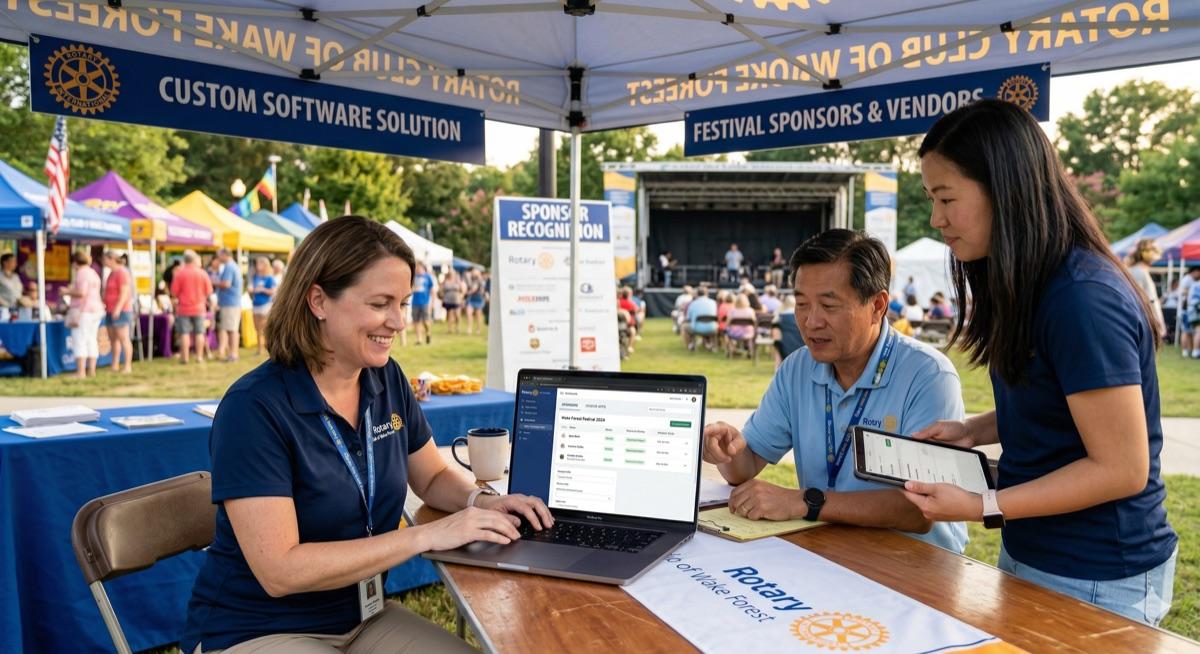
The nonprofit software problem
Most nonprofit CRM platforms are engineered for major gift fundraising: moves management, planned giving pipelines, donor wealth screening. That is the right tool for a large development office running capital campaigns. It is the wrong tool for a community-focused chapter managing volunteer coordination, event sponsorships, and vendor logistics for an annual street festival.
Volunteer coordinators and chapter leaders end up in one of two places: paying for an expensive platform that does not fit and requires constant workarounds, or relying on free tools too limited to be genuinely useful. Neither is a real solution.
What the Rotary Club of Wake Forest was dealing with
The Rotary Club of Wake Forest runs Cars & Carnivores, an annual street festival that depends on sponsorships for funding. Club members reach out to local businesses to secure those sponsors — but coordination was happening entirely through spreadsheets and email.
The result: members had no visibility into who was contacting which sponsor. Duplicate outreach happened. Conversations fell through the gaps between email threads. Leadership had no real-time view of where revenue stood heading into the event. The information existed — it was just scattered across a dozen inboxes and cells in a shared spreadsheet.
What we built: the Sponsor Tracker
We built a purpose-built sponsorship coordination tool designed around how the club actually operates:
- Personal dashboard per team member — each person sees their assigned sponsors, current status, and next steps.
- Team leaderboard — friendly visibility into progress across the full membership.
- Status pipeline — Contacted, In Discussion, Committed, Paid — moving sponsors through the funnel with a single click.
- Live revenue chart — leadership sees the dollar total update in real time as sponsors commit.
- Stripe integration — payment collection built directly into the workflow.
- Automated email notifications — each status change triggers the right message to the right person without manual follow-up.
The results
The club achieved a 100% contact rate across all assigned sponsors — every prospect was reached, no one was missed, and no sponsor was contacted twice by different members. Leadership could pull a revenue report instantly from the dashboard rather than asking someone to compile a spreadsheet. The coordination problem was structurally eliminated, not managed around.
The vendor portal
Cars & Carnivores also has a vendor side: food trucks, craft vendors, and exhibitors applying for booth space. That process was handled through email and paper applications — an administrator manually reviewing submissions, following up by hand, and collecting booth fees through separate channels.
We built a three-step public vendor portal to replace it:
- Apply — vendors complete a public application form that captures all required information.
- Review — administrators see all submissions in a single dashboard, approve or decline with one click.
- Pay — approved vendors pay their booth fee directly through Stripe, integrated into the portal.
Automated status emails kept applicants informed at every stage without any manual follow-up from the admin side. What had been a weeks-long email management task became a process the administrator could handle in minutes.
Why custom made sense here
No off-the-shelf tool does exactly this. Salesforce has a nonprofit tier, but it is engineered for development offices — wrong shape for a volunteer chapter running a community event. A spreadsheet upgrade would have helped at the margins but would not have solved the coordination problem or integrated payments.
The custom build cost less than a year of enterprise CRM licensing and solved the exact problems the club had — without requiring members to learn a platform built for a different kind of organization.
Frequently asked questions
Can nonprofits afford custom software?
Often yes — especially when compared to the alternatives. Enterprise CRM platforms charge monthly per-user fees that add up quickly and still require heavy customization to fit nonprofit workflows. A purpose-built tool can cost less than a year of an enterprise subscription and actually match how the organization operates.
Do you work with other nonprofits beyond Rotary?
Yes. The operational challenges we solved for the Rotary Club of Wake Forest — coordination across volunteers, event management, sponsorship tracking, payment processing — appear across many types of community organizations. If you have a workflow that generic tools cannot accommodate, we would like to hear about it.
Ready to talk about your project?
Tell us what you're building. Brad reviews every submission personally.
Start Your Project