How to Scope a Software Project (Without a Tech Background)
You do not need to know how to code to define what you need built. Here is the practical framework Kairos uses to turn a business problem into a buildable scope.
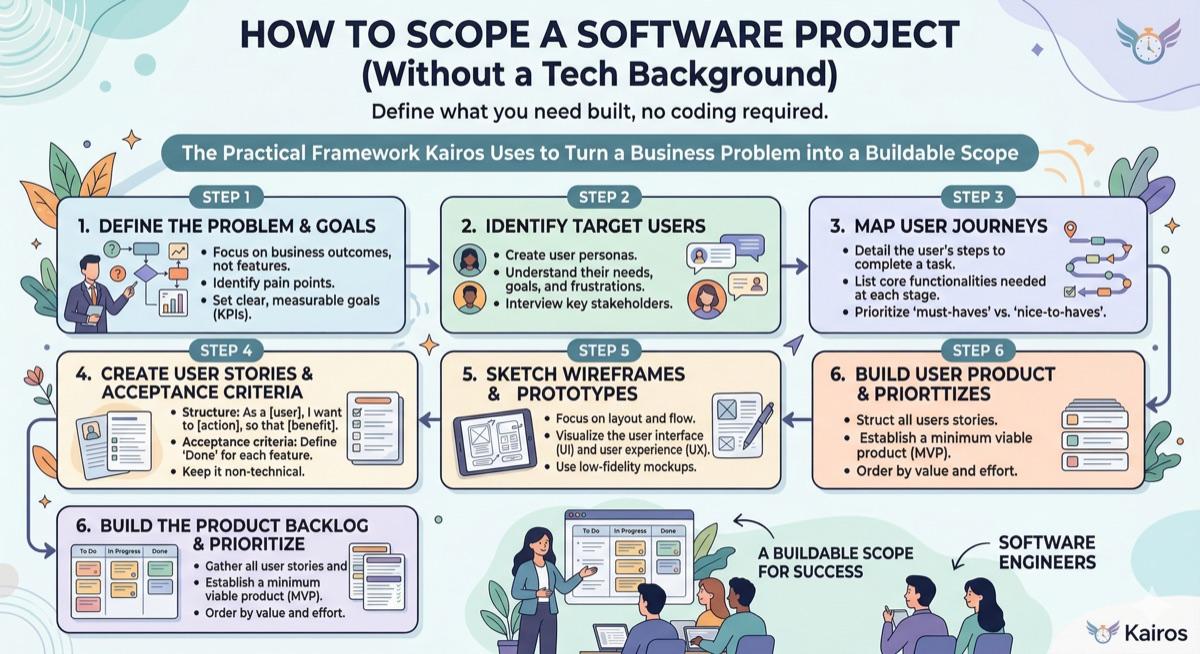
Why scoping matters more than anything else
A vague scope produces a vague estimate. A vague estimate produces surprises. That is the chain. And every step in that chain is avoidable.
The single biggest cause of software project failures is not bad developers or wrong technology choices. It is starting to build before the problem is fully understood. The developer builds something, the client sees it, and says “that is not what I meant.” Both parties are frustrated. Time and money are gone.
Good scoping breaks that chain before it starts.
Start with the problem, not the solution
Most people come to a software firm with a solution already in mind. “I need a mobile app.” “I need a customer portal.” “I need something like Salesforce but simpler.”
We always back up to the problem first.
“I need a mobile app” is not a problem. “My technicians do not have job details when they arrive on site and customers are frustrated by the lack of communication” is a problem. The solution — a mobile app, a text notification, a dispatch board — follows from the problem. Start with the solution and you may build the wrong thing well. Start with the problem and you have a chance to build the right thing.
The 5 questions that define any software scope
These five questions apply to every software project, from a simple admin tool to a multi-user platform. Work through them honestly and you have the foundation of a scope.
- Who uses it, and what do they need to do? Define your user roles (admin, technician, customer, manager) and the core workflows each one performs. If you cannot describe the three or four things each user needs to do, the scope is not ready.
- What data goes in, and what comes out? What information gets entered into the system? What reports, exports, or outputs does the business need? This question surfaces the real purpose of the software.
- What does it connect to? Does this need to integrate with QuickBooks, your CRM, your scheduling system, Stripe? Integrations are significant scope — they need to be identified upfront, not discovered mid-build.
- What must it NOT do? Stated exclusions are just as important as inclusions. If you are not building customer invoicing in this phase, say so. Exclusions prevent scope creep and set clear expectations.
- What does success look like at 90 days? A measurable outcome. Dispatch calls reduced by half. Applications processed in two days instead of two weeks. If you cannot define success, you cannot evaluate whether the project delivered.
What a good scope document looks like
Not a 40-page functional specification. Not a wireframe deck with 60 screens. For most SMB projects, a good scope document is two to five pages and contains:
- A clear narrative of user workflows — who logs in and what they do, step by step.
- A list of screens or features — not designed, just named and described in one or two sentences each.
- A list of integrations — every external system the software needs to talk to.
- Stated exclusions — what is explicitly out of scope for this build.
That document is enough to produce a reliable fixed-price estimate. If a developer needs more than that to give you a number, they are either being thorough (good) or stalling (ask why).
What happens if requirements change after scoping
Requirements always evolve. The question is not whether they will change but how changes are handled.
Minor clarifications within the agreed scope are expected and handled without extra process. If you described a feature one way and the implementation makes it clearer that a small adjustment is needed, that is normal and gets addressed without drama.
New features or changes to core requirements are a different matter. Those get documented as a scope change before any work proceeds. The change is described, the impact on timeline and price is assessed, and both parties sign off. Nothing happens without agreement. This process protects you from surprises and protects us from building the wrong thing.
Frequently asked questions
Do you help with scoping as part of the process?
Yes. The process starts with a discovery conversation where we work through your problem together. From that conversation we produce a scope document, and from the scope document we produce a fixed price. You do not need to arrive with a spec — just a clear description of the problem you are trying to solve.
What if I only have a vague idea right now?
That is fine. Most of our clients come to us with a problem, not a solution. The discovery conversation is designed to help you get from vague idea to concrete scope. If after that conversation the project is not a good fit for custom software, we will tell you that too.
Ready to talk about your project?
Tell us what you're building. Brad reviews every submission personally.
Start Your Project