Custom Software for Contractors: Job Costing, Subcontractor Management, and Project Tracking Without Enterprise Pricing
Construction management platforms like Procore are built for general contractors with 100+ employees. Here's what small and mid-size contractors actually need — and what custom software can deliver.
The enterprise software trap
Procore, Buildertrend, and CoConstruct are excellent platforms — for large contractors. For a 15-person commercial subcontractor or a residential builder doing 20 homes a year, they are expensive, complex, and packed with features you will never use.
Enterprise construction software is designed to solve enterprise construction problems. When you are paying for a platform built to manage a 500-person general contractor, you are subsidizing capabilities you do not need and fighting a UI built for someone else's workflow. That is a bad deal.
What small contractors actually need
Strip out the enterprise overhead and the core requirements for a small or mid-size contractor are not complicated:
- Job costing that tracks labor, materials, and subs per project against the original estimate.
- Subcontractor management: certificates of insurance on file, lien waivers collected before payment, invoice tracking per job.
- Change order tracking tied to the original contract — documented, approved, and reflected in the revised budget.
- Daily reports and photo documentation that field staff can submit from a phone.
- Invoicing tied to project milestones, not just calendar dates.
None of that requires a $500/month platform. It requires software built around how you actually run jobs.
Where contractors lose money without the right tools
The losses are usually quiet until accounting closes the books. Common patterns:
- Jobs that look on track in real time but show a loss once labor hours are tallied at month-end — because nobody was tracking costs against budget as work happened.
- Subcontractors who invoice twice, or get paid before the lien waiver is received, because the approval process lives in someone's email.
- Change orders that were discussed on-site and agreed to verbally but never formally documented — leaving the contractor absorbing scope additions with no contract backing.
- Material delivery delays that nobody tracked because the purchase order and the schedule lived in separate tools that never talked to each other.
What a custom build looks like for a contractor
Consider a mid-size residential builder doing 20 custom homes per year. A purpose-built system for that business might include:
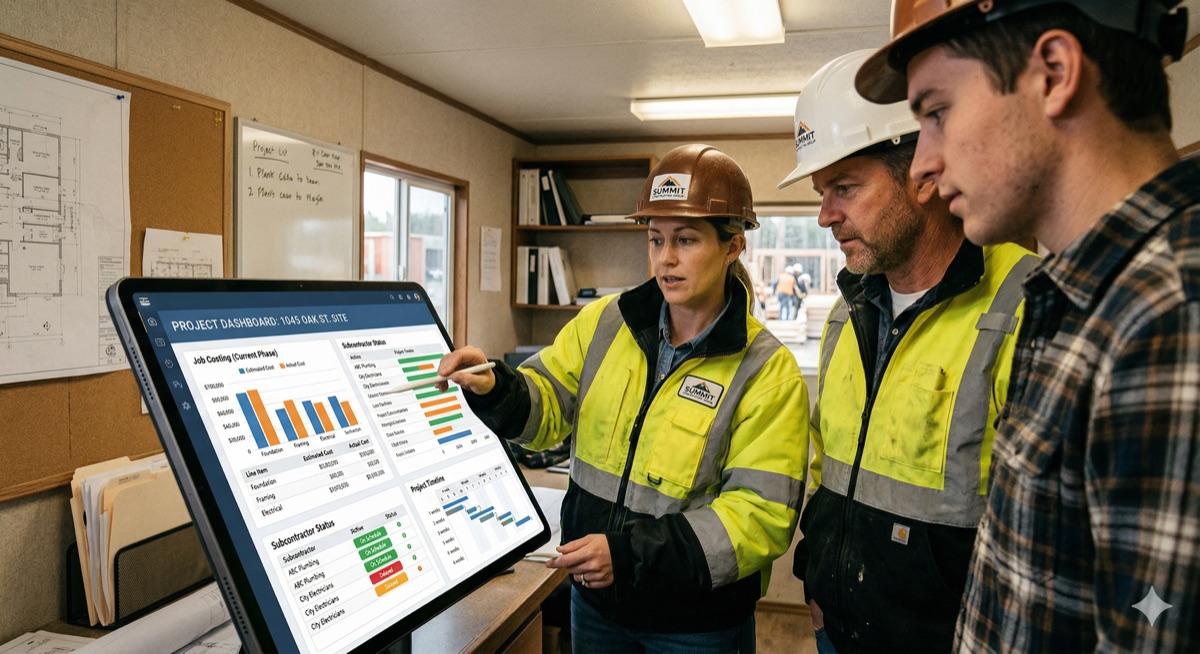
- A job dashboard showing all active projects, current phase, and cost-to-date versus budget at a glance.
- Per-job cost tracking that breaks down labor, materials, and sub costs against the original estimate, updated as invoices come in.
- A subcontractor portal where subs upload their COIs, submit invoices, and receive payment — with the system blocking payment if a lien waiver has not been received.
- Change order workflow: field staff submit a change request, it goes to the project manager for pricing, then to the owner for approval, and the signed change order updates the contract value automatically.
- Milestone-based invoicing that generates a draw request when a defined phase is marked complete.
- Mobile-friendly daily report form so field staff can submit weather, crew count, work completed, and photos from the job site.
Fixed price, built around your process
You do not get a template. The system is mapped to how you actually run jobs — your project phases, your approval chain, your subcontractor relationships, your invoice workflow. The discovery process clarifies exactly what to build before a price is set, so there are no surprises on scope or cost.
After 20+ years building custom software, Brad Walker has worked with enough construction businesses to know that the details matter. A change order workflow for a commercial sub looks different than one for a residential builder. Getting those details right upfront is the difference between software that gets used and software that gets abandoned.
Frequently asked questions
Can this integrate with QuickBooks?
Yes. QuickBooks integration is one of the most common requests from contractors. Job cost data, invoices, and payments can sync between a custom system and QuickBooks so your accounting stays in one place. This gets scoped and built as part of the project.
What about project scheduling and Gantt charts?
Scheduling can be included in a custom build. Whether that means a simple milestone timeline, a full Gantt view, or integration with an existing scheduling tool depends on what your team actually uses. We scope it based on your workflow, not a feature checklist.
Ready to talk about your project?
Tell us what you're building. Brad reviews every submission personally.
Start Your Project