Custom Software for Plumbing Companies: Dispatch, Service History, and Invoice Recovery
Generic field service apps were not built for plumbing. Same-day emergencies, service history per fixture, parts on the truck, and unpaid invoices all live in different places. Here is when custom software for a plumbing company actually pays for itself.
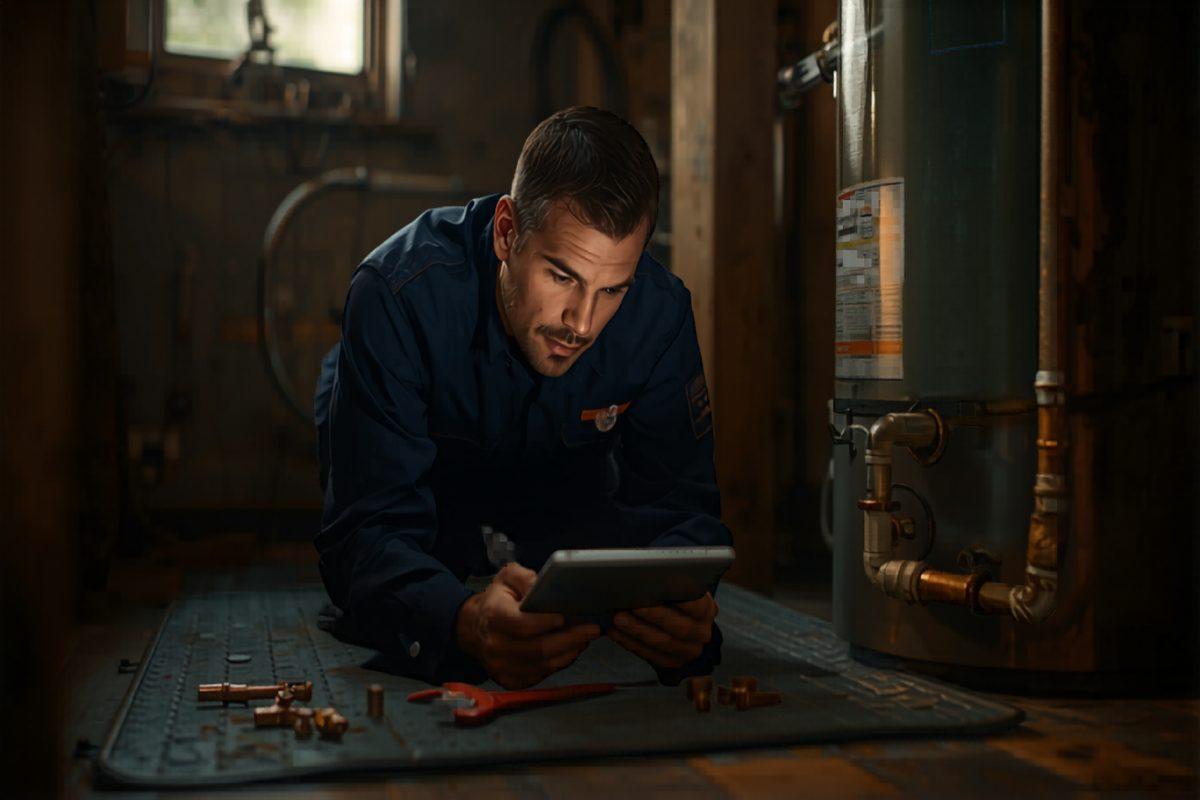
Plumbing is a margin business that runs on chaos. The phones ring at 7:15 a.m. with two leaks and a clogged main, the dispatcher is moving five trucks around a city to keep promises that were made before any of them were on the road, and somewhere in the office a stack of unpaid invoices is older than thirty days. The customer who called on Tuesday for a faucet replacement is the same one who is going to call in eighteen months when a different fixture starts dripping — and your tech is going to walk into that house with no idea what was done last time.
Most plumbing companies start with a dispatch app, a separate price book, QuickBooks for billing, a notebook in the truck for parts, a shared inbox for permits and inspections, and a sticky note on the fridge for backflow tests due this month. As the volume grows, the gap between those tools stops being a minor annoyance and starts to be where money leaks. A missed callback is a thousand dollars. A part that was on the truck but not on the invoice is fifty dollars and an angry customer the next time it shows up. An aging receivable nobody is chasing is real cash sitting on a desk.
This post covers what custom software for a plumbing company actually looks like, where the off-the-shelf options stop short, and the type of operation that benefits most from building rather than renting.
Why plumbing is different from generic field service
Generic field service apps assume a customer calls, a tech is dispatched, the work is done, and an invoice goes out. That model sort of fits plumbing, but it skips the parts that actually run the business. The differences are structural:
- Same-day urgency is the default. A burst supply line is not a Thursday appointment — it is a now problem. The system has to absorb a steady stream of emergency calls, route them by tech proximity and skill, and reshuffle the existing schedule without dropping the customer who was already promised a window.
- Service history lives at the fixture, not just the address. Generic CRMs put a note on a customer record. A plumbing customer needs a record per water heater, per backflow assembly, per main shutoff, per drain line — with install dates, warranties, and the last three service visits attached. The next tech needs that history before he rings the bell.
- Flat-rate and time-and-materials run side by side. A drain clearing is flat rate. A repipe is T&M. A new-construction rough-in is a fixed contract. The same company runs all three, and the system has to price, invoice, and track each one without forcing every job into the same template.
- The truck is the warehouse. A plumber carries hundreds of parts in a service van. Knowing what is on which truck — and what got installed in a job versus what came back at the end of the day — is the difference between a clean inventory and a slow leak of small parts margin.
- Permits and inspections are real work. Water heater swaps, sewer lines, gas work, and backflow testing all carry permit and inspection requirements that vary by jurisdiction. The system has to track where a permit is in the cycle and who is responsible for closing it out, or jobs sit open for months.
- AR is a profession, not a side task. Plumbing companies finish the work and hand the customer an invoice on the spot — but a meaningful chunk of those invoices, especially commercial and property management work, get paid in thirty, sixty, or ninety days. The dollars that age out without a follow-up are real money, and the office needs a system that chases them automatically.
What the off-the-shelf platforms get right — and where they stop
There are real options in this space. ServiceTitan is the dominant platform for mid-size and large residential service companies and covers dispatch, flat-rate, and reporting at a depth most operators never need. Housecall Pro and Jobber are popular with smaller operators who want fast onboarding and clean mobile apps. FieldEdge sits in the middle. Workiz is common with smaller service trades.
For a single-channel residential service company on flat-rate pricing, one of these will cover most of the workflow. The cracks tend to show up in three patterns:
Mixed business models. Many of the plumbing companies that grow past a certain size run residential service alongside commercial maintenance, new construction rough-ins, and a backflow testing program. Each of those has different pricing, different sales cycles, different paperwork, and different reporting needs. Generic platforms force you to bend the secondary lines of business into the dominant workflow, or buy a second tool and bridge the data by hand.
Per-tech pricing on a growing team. Per-user SaaS pricing scales linearly with the size of the field team, regardless of revenue per tech. A company that adds five apprentices in a year is suddenly paying meaningfully more for the same software, and the platforms have no incentive to share the efficiency.
Reporting and automations that do not match how you operate. Owners want margin by job type and by tech. Service managers want callback rates and warranty work isolated. Office managers want aging receivables sliced by job source and customer type. Every shop has a slightly different definition of what counts as a callback, a closed job, or a paid invoice, and the off-the-shelf platforms force you into theirs.
What custom plumbing software typically includes
Most builds we scope cluster around the same core set of modules. The exact mix depends on the balance of residential service vs. commercial vs. construction, and which adjacent programs the company runs. The recurring pieces:
- Dispatch and scheduling — a board view of techs, days, and calls, with drag-to-reschedule, skill-based assignment, and live drive-time estimates so the dispatcher can absorb an emergency without breaking the rest of the day.
- Customer and property records — a single object per address that tracks the building, the owners, every fixture installed, every service visit, every warranty, and every photo, so the next tech walks in already knowing the history.
- Mobile work orders — a phone-first app for the tech that shows the job, the customer history, the flat-rate price book, the parts list, photo capture, customer signature, and same-day invoicing without going back to the office.
- Flat-rate price book with T&M override — the same job can be quoted from a flat-rate book, switched to time-and-materials when the scope changes, and invoiced cleanly either way, with the price book centrally managed and updated by the office.
- Truck stock and parts — a simple inventory tied to each truck, with parts consumed against jobs, restock alerts, and a daily reconcile against what the tech actually used so margin does not leak through the parts cabinet.
- Backflow program management — a calendar-driven workflow for annual backflow testing, with customer reminders, permit submissions, reports filed to the local water authority, and automatic invoicing on completion.
- Maintenance contracts and recurring work — service agreements with scheduled visits, prepaid hours, member-only pricing, and automatic renewals, tracked separately from one-off service revenue.
- Permits and inspections — a status board for permits pulled, inspections scheduled, and final sign-offs, so jobs do not sit open while the office assumes the field handled it and the field assumes the office handled it.
- Invoicing and AR with QuickBooks sync — invoices generated on the spot, payments captured in the field, and the office side reconciled to QuickBooks Online without manual entry. Aging buckets and automated follow-up emails for receivables past 30, 60, and 90 days.
- Customer-facing portal — homeowners and property managers can see scheduled visits, signed work orders, paid invoices, photos, and service history without calling the office.
- Reporting that matches how you actually run — gross margin by job type, callback rate by tech, average ticket by service category, AR aging by customer segment, sliced the way the owner thinks about the business.
None of these features is unique to custom software in the abstract. The point of building custom is that all of them work the way your shop runs, in the same system, without the manual reconciliation that comes with stitching three or four off-the-shelf tools together.
Service history is where customer lifetime value lives
The single most underused asset in a plumbing company is the service history file. The third water heater a customer has bought from you in fifteen years is worth more than the marketing dollars it would take to acquire a brand-new customer. The repeat customer is sticky, predictable, and pays. But repeat customers only happen when the company can find them again — and find what was done last time without making the homeowner repeat the story.
That means the data model has to put service history at the fixture, not just the address. A water heater installed in 2019 has a warranty, a model number, a serial number, a brand, a thermostat setting, an expansion tank, and a flush schedule. When that customer calls in 2026, the tech needs to walk in already knowing the brand of the heater, the warranty status, and that the expansion tank is seven years old and probably the actual problem. Off-the-shelf platforms put a note on the customer record. A custom system lets you model the truth — which is that the customer owns a building that contains many fixtures, each with their own life of their own.
AR follow-up is where dollars are sitting on the desk
Most plumbing companies have somewhere between five and fifteen percent of monthly revenue tied up in receivables that should be paid and are not. Some of that is residential customers who slipped through the cracks and need a phone call. Most of it is commercial and property-management customers on net-30 or net-60 terms with no one consistently chasing them. Every week that aging slides further out is a week the cash is not in the bank.
Generic platforms surface AR as a report. They do not chase it. Custom software can run a real follow-up cadence — automatic emails at 30 days, escalating language at 45, a list for the office manager at 60, an owner-flagged review at 90 — with the full job context attached so when the customer calls back, the person on the phone has the photos, the signature, the invoice, and the history without digging.
Who benefits most from a custom build
Not every plumbing company needs custom software. The ones that benefit most have at least two of the following:
- A mixed book of business — residential service plus commercial maintenance, new construction, or a backflow program — that does not fit cleanly into a single-channel platform.
- A growing field team that has outgrown per-tech SaaS economics, especially when the office wants reporting and automations that the platform cannot bend to fit.
- A meaningful service contract or maintenance program where recurring revenue, member pricing, and renewal tracking are real levers on the business.
- A backflow testing or specialized inspection program with jurisdictional reporting requirements that the off-the-shelf platforms either ignore or charge a premium for.
- A repeat customer base where service history per fixture would change the way techs sell on the truck and the way the office markets to existing accounts.
- An AR problem the office knows about and has not solved — usually because no one has time to chase it consistently and the platform does not chase it on its own.
If a shop is brand new or running a single-truck residential operation, an off-the-shelf platform is almost always the right answer. Custom software is most useful when the volume and the workflow complexity are real enough that the workarounds in a generic tool start costing real money every week.
What a build looks like in practice
We start with the workflow, not the screens. Before any code is written, we map the actual operation: how calls come in, how the dispatcher decides who goes where, how a tech invoices on the truck, how parts get reconciled at the end of the day, how AR gets followed up, and where the office spends time fixing problems after the fact. The custom software is built around that map.
Most plumbing builds ship the core operation first — dispatch, customer and property records, mobile work orders, flat-rate price book, and QuickBooks-synced invoicing — and add backflow program management, recurring contracts, truck stock, and AR automation in later phases. That sequencing keeps the project tight and gets the business value into the field early.
Fixed price. No hourly billing. The scope and cost are agreed before any code is written, and we build against that scope.
Frequently asked questions
What plumbing software platforms exist already, and where do they fall short?
ServiceTitan, Housecall Pro, Jobber, FieldEdge, and Workiz are the most common platforms used by plumbing companies. They cover the basics — dispatch, invoicing, customer records — well enough for a single-truck residential operator. The cracks tend to show up when a company runs both residential and commercial, handles construction or new-build work alongside service, manages a backflow testing program, runs flat-rate and time-and-materials billing on the same job, or tracks fixture-level service history that the platforms cannot model.
Can custom plumbing software integrate with QuickBooks and a flat-rate price book?
Yes. QuickBooks Online has a well-supported API for invoices, customers, and payments. A custom build can sync invoices and payments automatically so the office is not double-entering. Flat-rate price books from Profit Rhino or a custom internal book can be loaded directly into the dispatch app, so a tech sees the right price for the right task on a phone, with the option for time-and-materials override on the same job.
How long does it take to build custom software for a plumbing company?
A focused first build — dispatch, customer and property records, mobile work orders, flat-rate price book, and QuickBooks-synced invoicing — typically ships in eight to twelve weeks once the scope is defined. Adding backflow program management, recurring service contracts, parts-on-truck inventory, and AR follow-up extends the timeline. We scope the project before any code is written, so the timeline and cost are known up front.
If your plumbing operation has outgrown the platform you started on, start with a conversation. We will scope the workflow before talking about a build.
Ready to talk about your project?
Tell us what you're building. Brad reviews every submission personally.
Start Your Project